
Two noteworthy articles bleeped onto my radar on the same day recently. The first was a post about “Alcohol Use, Screening, and Brief Intervention Among Pregnant Persons — 24 U.S. Jurisdictions, 2017 and 2019” and the other was “2023’s Best & Worst States to Have a Baby” from WalletHub.
I fully realize that WalletHub is not the pinnacle of research, but research was done – by someone – to compile that list, and so I did a bit of my own research, too, and here’s what I found: Of the NINE worst states to have a baby, five show up on two other “worst” lists. One is “Drug Use by State,” again from WalletHub, and the other is excessive alcohol use by state from US News & World Report. Three other states, Arkansas, Indiana, and Arizona, earn dishonorable mentions for worst birth outcomes and worst drug use (Arkansas and Indiana) and worst birth outcomes and excessive alcohol use (Arizona) in the top twelve worst states. (US News; WalletHub Best; WalletHub Drug)
This means that five of the nine worst states to have a baby are also five of the nine states with both excessive alcohol and excessive other drug use. Am I the only one who assumes there’s a connection?
Which leads to the second article, the one about screening for pregnant persons. First, screening isn’t done enough nor is it done consistently. And, as the title indicates, we aren’t necessarily screening for what we should. Alcohol is a drug. Alcohol is a drug. Alcohol is a drug. But it’s not the ONLY drug, so if a doctor asks a pregnant person about alcohol use, there’s a chance that alcohol isn’t being used but another drug is. So that’s problem number one: when we screen, what are we actually screening for? The Child Abuse Prevention and Treatment Act, the federal legislation addressing child abuse and neglect enacted in 1974 had to be revised in 2016 (!) “to develop the plans of safe care for infants affected by all substance use (not just the use of illegal substances, as was the requirement prior to this change).” (Child)
However, with the opioid crisis taking its toll on all of the US, too many people forgot that alcohol is a drug. Therefore, “despite recommendations for universal alcohol screening, approximately 20% of pregnant persons were not screened for alcohol use at their last visit to a primary health care provider, and among those with past 30-day alcohol use, only 16% who were screened were advised by a health care provider to quit drinking or reduce their alcohol use.” (CDC) Put another way, 84% of those screened regarding their alcohol use weren’t offered advice about reducing or quitting drinking. So they’re screened, but they are given no feedback as to changing behaviors, and that tidbit of information – that the pregnant person is drinking – is buried in a file, never to be addressed.
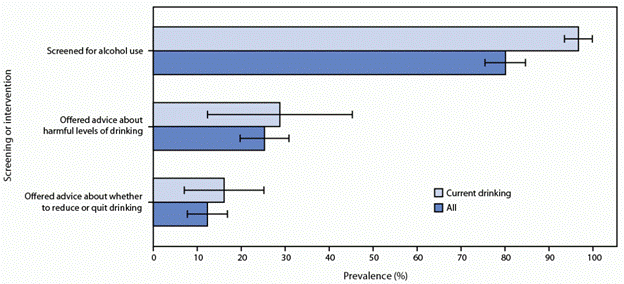
(CDC)
Imagine if a pregnant person were asked whether or not she ate raw sushi, she answered “yes,” and nothing else was said. Mind boggling.
Now, add to this that addiction is a disease. Are all people who use substances while pregnant suffering from the disease of addiction? Probably not, but when we consider that people invariably want the best possible outcomes for their unborn children, those who are merely ignorant to the damage that alcohol and other drugs can do in utero would immediately stop using them – once they are told. But, if they are addicted, education and referral to treatment is vital. But 84% of the time, that step is missing for both populations.
And, it gets worse. “Some groups of pregnant persons, such as those who did not graduate from high school and those who did not report behaviors that might increase the risk for HIV transmission, reported lower prevalences of screening compared with those who graduated from high school and those who reported behaviors that might increase HIV transmission risk.” (CDC)
We know what needs to happen: we need better screening and better testing to determine that babies aren’t born under the effects of alcohol and other drugs. Addiction is a disease, but it’s one that too many people are uncomfortable addressing. But babies are negatively affected because of that reluctance. We need to do better.
References
https://www.cdc.gov/mmwr/volumes/72/wr/mm7203a2.htm
https://www.childwelfare.gov/pubs/factsheets/about/
https://wallethub.com/edu/best-and-worst-states-to-have-a-baby/6513
https://wallethub.com/edu/drug-use-by-state/35150
 Guided by Guida
Leave a comment