
For the last fourteen years or so, I’ve been doing assessments to determine whether or not people have substance use disorders (SUDs). We all know that the younger a person starts using substances, the more likely that a SUD will develop, so my assessments always include a version of the following questions: “How old were you when you first drank alcohol…not a sip of a parent’s but your own?” “How old were you when you first smoked cannabis?” “How old were you when you first used cocaine?” I have, of course, gotten a variety of answers.
But here’s what I have found to be remarkable…and not in a good way: When I first started doing assessments, a good portion of the time – probably 65 to 75% – I’d get a shocked response to the question about cocaine use. Only about 30% of the time would someone just provide an age. Mostly I’d get, “I’VE NEVER USED COCAINE!” Fast forward to the last few years, and no one even blinks. It seems that nearly everyone who is being assessed by me for a possible substance use disorder has used cocaine.
I realize this is all anecdotal, and I can’t find any empirical data to support my anecdote. Here are just a few reasons why I can’t find stats to support it: the US doesn’t consider alcohol a drug; we have spent an inordinate amount of energy and money on opioid misuse and so are missing the bigger picture about addiction; we somehow think that if we just ask the questions we’ll miraculously get accurate answers; even thinking that, we rarely ask the questions, so taboo is talking about substance use disorders in our society; we also believe that there’s a huge distinction from school-aged individuals to adults, despite knowing post school-aged brains continue to develop until around the age of 25 years old.
So imagine my surprise when I found out, in a newly published study entitled “Seasonal Variation of Use of Common Psychedelics and Party Drugs Among Nightclub/Festival Attendees in New York City,” that the peer-reviewed Journal of Psychoactive Drugs has indicated that cocaine is a party drug!
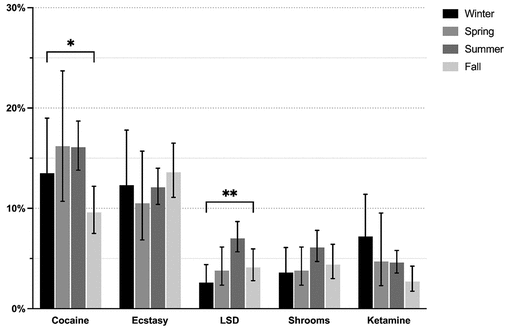
(Palamar, Rutherford, Le & Keyes)
Cocaine is typically considered one of the three most addictive drugs, which used to be the opposite of party drugs. Party drugs were those drugs available at a party that weren’t typically used otherwise. At least the American Academy of Family Physicians (AAFP) seems to agree with me. The explanation that the website uses, which is as good as any, is that “Club drugs are favored over other recreational drugs, such as marijuana, lysergic acid diethylamide (LSD), methamphetamine, and opiates, because they are believed to enhance social interaction. They often are described as ‘entactogens,’ giving a sense of physical closeness, empathy, and euphoria.” (Gahlinger)
The AAFP also reports that “In the past 10 years, there has been a generalized decrease in the use of marijuana, cocaine, and heroin in the United States […]. However, during this same period, the use of club drugs has dramatically increased. A 2001–2002 Chicago household survey of 18-to 40-year-old persons showed that 38 percent had attended a rave, and 49 percent of these had a taken a club drug.” (Gahlinger) This gives me more evidence that cocaine isn’t a club drug…or at least it hadn’t previously been considered one.
But remember how I mentioned that we don’t like to talk about this stuff? Well, in not talking about it, we currently have no common language around substance use disorders. What are club drugs? Are they different than party drugs? Are party drugs the same as recreational drugs? I really have no idea. Give it a Google, and you’ll be as confused as I am.
I think this may explain why many people see the use of cocaine as common. And that scares me half to death. I’m not proposing a Refer Madness response, but I really do think we need to get a handle on our society’s desire to be in an altered state.
Not unrelated, George Koob, PhD, director of the National Institute on Alcohol Abuse and Alcoholism (NIAAA), recently told the Daily Mail that if the US switches its alcohol guidelines in any way when they are reviewed for 2025, he’s “pretty sure” that they aren’t going to go up and so therefore “would be toward Canada,” which changed its classification in January 2023 of “low-risk” alcohol consumption to no more than two drinks per week. Koob indicates that there are “no benefits” to drinking alcohol (Andrews), which a June 2023 study mirrored, finding that ANY (emphasis mine) “alcohol consumption was associated with significantly higher risks of 61 diseases, including 33 not previously reported as alcohol-related.” (Im, Wright, and Yang)
That’s it. That’s all Dr. Koob said. So the derision – and misinformation – that Reason writer Eric Boehm heaped upon him is surprising; Reason writers are usually more, well, reasoned. But Boehm seems to have drunk the Kool-Aid when it comes to the idea that people simply cannot have fun without being under the influence of substances.
Alcohol is bad for you. Cocaine is quite addictive. Heroin can kill you fast. Ketamine abuse is on the rise. We all take risks, but some are more carefully considered than others. Make sure your risks are calculated.
References
Andrews, Luke. https://www.dailymail.co.uk/health/article-12438233/Americans-limited-two-beers-strict-new-alcohol-guidelines-Bidens-booze-czar.html
Boehm, Eric. https://reason.com/2023/08/25/americas-alcohol-czar-wants-stricter-federal-guidelines-for-drinking/
Gahlinger, Paul, M.D., Ph.D., M.P.H., https://www.aafp.org/pubs/afp/issues/2004/0601/p2619.html
Im, P.K., Wright, N., Yang, L. et al. Alcohol consumption and risks of more than 200 diseases in Chinese men. Nat Med 29, 1476–1486 (2023). https://doi.org/10.1038/s41591-023-02383-8
Palamar, Joseph J., Rutherford, Caroline, Le, Austin & Keyes, Katherine M. (2023) Seasonal Variation of Use of Common Psychedelics and Party Drugs Among Nightclub/Festival Attendees in New York City, Journal of Psychoactive Drugs, DOI: 10.1080/02791072.2023.2240322
 Guided by Guida
Leave a comment