
This blog has been edited from the original.
Last week I had the privilege of traveling to Washington, DC, to be part of FASD United’s Impact Week. I met a fellow Wisconsinite, and we started devising a plan for more advocacy in our state; I met with an aide from my Congressman’s office to discuss the FASD Respect Act and ask for co-sponsorship; and I met so many awesome advocates, including self-advocates.
One such self-advocate, Justin Shepherd, told his story about how, only about one year earlier, while making The FASD Project, a documentary about FASDs (https://thefasdproject.org/), he received a diagnosis of the FASD Alcohol-Related Neurobehavioral Disorder (ARNB), at the age of 41, because, during interviews, he learned aspects about the disorder that struck a chord with him. And, while he was telling his story, something struck a chord in me.
I’ve been an expert in FASDs since 1989. I worked in a group home for children whose parents misused substances, and I was educated in all aspects of neonatal alcohol and other drug exposure. As the years went by, I learned and trained, and one of my standard lines was, “Who knows? My IQ would perhaps be a couple points higher if my mom hadn’t drank alcohol while she was pregnant with me.” But I never really considered that I could actually have an FASD, until I listened to Justin. Well, him and Rebecca. As luck would have it, I met Rebecca Tillou in an elevator at Impact Week. I thought, “Oh! She reminds me of me!” Passion for her cause – that of raising awareness about FASDs – just emanated from her, and she didn’t seem to have even a modicum of an edit button. I had literally found one of my people. I learned that Rebecca was adopted as a baby and not diagnosed with Fetal Alcohol Syndrome (FAS) until she was 34 years old…about 9 years ago.
After learning from Justin why he sought a diagnosis, I called my husband and said, “I think I have an FASD. I think I have an Alcohol-Related Birth Defect (ARBD).” He thought I was kidding. Why wouldn’t he?
I’m in my late 50s, and the study of FASDs started well after I was born. As fate would have it, my mother drank alcohol while she was pregnant with me. I don’t know how much or how often, but she told me that she did. I certainly hold no ill will towards her. She had no idea. Gosh, to this day people – even doctors – will argue that drinking “a little” or “moderately” during pregnancy won’t harm the fetus.
I am the baby in a family of 7 live births, and I know for an absolute fact that I was unplanned. I will go so far as to say that I was probably not a pleasant surprise. I’m fairly sure that my mom had no intention of having another baby when she found herself, at the age of 39, pregnant with me. So, again, I certainly can’t blame her for drinking while carrying me. She had no idea.
But Mom drinking during pregnancy isn’t proof of my having an FASD. According to the American Academy of Pediatrics, “Individuals with Alcohol-Related Birth Defects (ARBD) only have problems with congenital anomalies caused by prenatal exposure to alcohol and do not show evidence of neurocognitive or neurodevelopmental deficits (ND-PAE or ARND). ARBDs are caused by the impact of prenatal exposure to alcohol on how an individual’s organs were formed and/or how they function, including the heart, kidney, bones, as well as hearing and/or vision. ARBD is uncommon” (aap.org).
I’ve done some googling, and, while I’m not qualified to diagnose FASDs for anyone, here’s what I do know: “Children with FASD have been shown to have a high prevalence of ophthalmological abnormalities in previous studies. Subnormal visual acuity (VA) [… and] refractive errors […] are well documented in FASD” (ncbi).
“Median VA in right/left eye (OD/OS) was 20/32/20/32 (0.2/0.2 logMAR) in childhood and 20/22/20/20 (0.05/0.0 logMAR) in adulthood. Median (range) refraction OD/OS was +0.88/+1.25 (-8.75 to +4.75/-9.38 to +5.25) spherical equivalent diopter (D) in childhood and -0.25/-0.25 (-12 to +2.75/-13.25 to +2.63) in adulthood. Astigmatism (≥1 D) was the most common refractive error, in 13 (40%) and 14 (47%) subjects, respectively (pubmed).
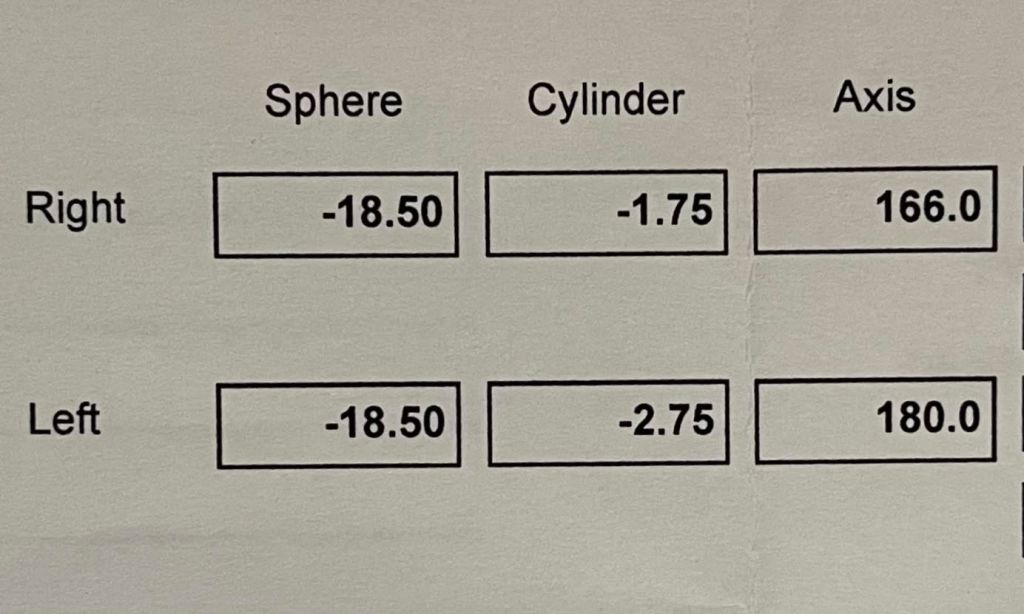
I don’t really understand the numbers on my eye prescription, but here’s why I’m pretty sure that I have the FASD of ARBD: my vision was fine until I was in third grade, then I could no longer see writing on the blackboard even with my desk pushed up to it. Despite my blaming Ms. Levy for writing too lightly, I had developed nearsightedness (myopia) seemingly overnight. While all my siblings wear glasses, even though neither of our parents did, none of them have the same sort of “subnormal visual acuity” that I do. While “high myopia” is considered to be myopia with a refractive error greater than -6, today my prescription for glasses is -18.50 in both eyes. I have an astigmatism of -1.75 in my right eye (moderate) and -2.75 in my left eye (severe).
I’m still processing what this could mean for me, and I’m not certain I’ll ever get an official diagnosis. Knowledge is power, though, and I can’t be the only person with these circumstances. How many more of us can there be? One in 20 isn’t rare, and there are so many more than that who just don’t know.
Update! Upon further review, the answer is “no”
I’ve been encouraged by advocates to get an official diagnosis, but I wasn’t even sure where to start. I figured an expert could answer my question over email, so that’s exactly how I proceeded. I emailed Wisconsin’s foremost expert on FASDs, and he wrote back! He said, in part, “If I understand your article correctly, your suspicion is based on your mother’s admission of drinking during the pregnancy, and your diagnosis of high myopia, correct? If so, I would not consider this a diagnosis of ARBD. ARBD is the rarest FASD and is a diagnosis meant to account for the very small number of people with prenatal alcohol exposure (PAE) and facial features or other birth defects associated with PAE but typical neurological development and behavior. It’s most often used as a placeholder for children who were exposed and have facial features of FAS but are too young to know if they have developmental or behavioral effects.”
References
https://www.ncbi.nlm.nih.gov/pmc/articles/PMC9990666/#R12
https://pubmed.ncbi.nlm.nih.gov/31926885/


 Guided by Guida
Leave a reply to GuidaBrown Cancel reply