
Fetal Alcohol Syndrome (FAS) was first diagnosed in 1973 by Dr. Kenneth L. Jones and Dr. David W. Smith, both pediatricians from the University of Washington’s medical school. They specialized in dysmorphology, the study of congenital abnormalities that arise during development. Dr. Smith died in 1981, but Dr. Jones is still fighting the good fight. Unfortunately, that fight has become an uphill battle from where I’m standing.
It’s over 50 year later, and we still have too few doctors diagnosing Fetal Alcohol Spectrum Disorders (FASDs), the umbrella term used for describing the range of physical, behavioral, and cognitive impairments that can result from prenatal alcohol exposure (PAE). Because we don’t have diagnoses, we believe the disorders don’t exist. And, because only 10% of those with an FASD actually have Fetal Alcohol Syndrome, which typically includes facial dysmorphology, those who should recognize the effects of PAE don’t.
The diagnoses, per the American Academy of Pediatrics, are the following: Neurobehavioral Disorder Associated with Prenatal Alcohol Exposure (ND-PAE), Alcohol-Related Neurodevelopmental Disorder (ARND), Fetal Alcohol Syndrome (FAS), Partial Fetal Alcohol Syndrome (PFAS), and Alcohol-Related Birth Defects (ARBD). (AAP)
We have too few states identifying and treating FASDs, so they certainly aren’t accurately counting cases. We have too few people who even know what they are. And we have too many people who believe that a drink or two during pregnancy isn’t harmful to the fetus despite evidence that alcohol is the most common known non-genetic cause of mental retardation in the United States. That means that, in the US, alcohol is the most common cause of mental retardation that is NOT INHERITED.
Oh, I know; I know: “That would never happen to me.” But how can you be so sure? According to the National Institute of Health, gestational age at time of pregnancy awareness is 5.5 weeks. (NIH) How much damage can be done in those first five and a half weeks? Oh, you don’t know…? Yeah, neither does anyone else.
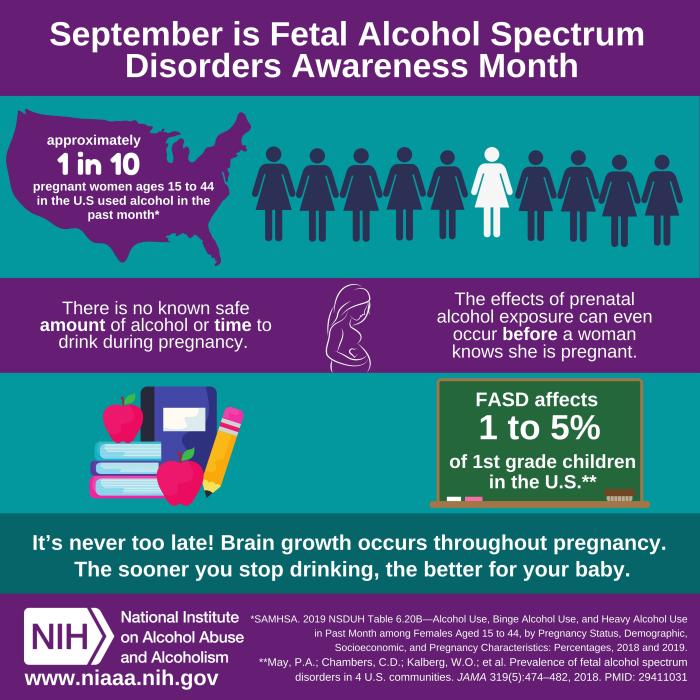
But that’s before they even know they’re pregnant. Nationally, between 2018 and 2020, 13.5% of pregnant adults in the US reported continued drinking, and 5.2% reported binge drinking in the previous 30 days. (CDC) What does “continued drinking” mean? Yeah, we don’t know THAT, either, because my drink and your drink are likely not the same thing. I may overpour, you may drink beer with a higher alcohol content than is standard, and my friend’s glass of wine may be never-ending.
But doctors are paying attention, right? Wrong. Estimates indicate that FASDs occur in up to 5% of the US population. (Baylor) Conservatively, that’s one child in every classroom. FASDs are more common than autism, yet we all know someone with an autism diagnosis. Something seems off.
Dr. Jones was recently a panelist at the 2024 Public Meeting of the Interagency Coordinating Committee on Fetal Alcohol Spectrum Disorder (ICCFASD). You can watch that here, which I highly recommend: https://videocast.nih.gov/watch=54088
At about 3:06:05 (yes…it’s 5+ hours long, but the first parts are the best, IMHO), Dr. Jones says, “I’m a pediatrician, as well, and I must tell you, I would bring up a rather controversial idea here. I, as a pediatrician, think that we have failed miserably, as far as trying to get physicians, in particular pediatricians, involved in this disorder. And so I am pushing at this point to bring in other people, like social workers and public health workers and people that really care about this disorder. Because I don’t think…and this is [a] way out comment for me…I don’t think that we care…I’m talking about pediatricians now…I don’t think we care about this disorder, and so I sort of am moving away from the medical profession as far as this is concerned to bring in people in public health and people who are really committed to this disorder.”
I get it. Doctors have a lot to do…they have what amounts to unfunded mandates. “Talk to your patients about interpersonal violence.” “Make sure that your patients know about proper diet.” “Remind your patients not to mix prescriptions.” “Tell your pediatric patients not to take drugs from others.” (That’s a new one: https://www.medpagetoday.com/special-reports/features/110186) “Oh, yeah, and diagnose and treat what they actually came in for.” It’s a lot.
Doctors can’t do it themselves. They need all of our help to educate about the harmful effects of PAE and diagnose FASDs.
Who’s with me?
References
https://www.aap.org/en/patient-care/fetal-alcohol-spectrum-disorders/common-definitions/
https://www.cdc.gov/mmwr/volumes/71/wr/mm7101a2.htm#T1_down
https://www.ncbi.nlm.nih.gov/pmc/articles/PMC5269518/
 Guided by Guida
Leave a comment