
I recently became acquainted with the concept of “lagom,” which, best as I know, is a Swedish word that translates to “just the right amount,” or “not too much, not too little.” You know when, usually at the beginning of the year, we’re supposed to identify our word…as in the word that is going to be our focus or theme to guide us through the year? Well, my word is always the same: “enough.” Or, if I’m being fancy, it’s the Gaelic version: “go leor.” I love this word for what it means…“enough”…and for what we’ve interpreted it to mean in English…“galore,” meaning “plenty.” As I like to remind myself, “I have enough. I do enough. I am enough.” In fact, I have go leor. And I also have lagom.
Because of this, lagom fascinates me. The article I first learned of it from is here: https://bigthink.com/mini-philosophy/swedish-philosophy-lagom-just-enough/
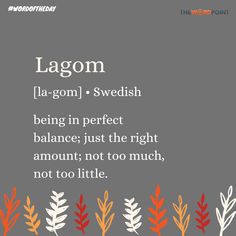
It talks about stopping at enough rather than going for it all in a way that may not be healthy or even fun, as in drinking too much to have fun. Or, as my friend MW says, “If one piece of cake is good, two are better” when explaining society’s belief about using mind-altering substances.
It’s like we don’t know when to say “enough.” We don’t realize that we don’t have to drink to drunkenness to have fun. We don’t have to try every drug imaginable to fit in. We don’t have to live in an altered state. So why do people feel as if they do? Why do young people say that if they aren’t going to get drunk then what’s the point of drinking? Why is addiction in this country rampant…affecting at least 12% of the population? That’s one in every eight people, and I’d contend that that’s a low estimate.
Are the Swedes doing better than we Americans? Unlikely. About 10% of the population drinks alcohol to the point of risk or dependence (research). Add to these numbers those who use cannabis and amphetamines, as well as other drugs, and you’d get stats similar to those of the US (science).
Sweden’s policy is geared towards criminalization as well as prevention, treatment, and control, whereas the US drug policy is to criminalize and control. But this isn’t about drug policy…this is about society’s desire to have more or to be altered.
What if we all believed in lagom…that having just the right amount is just right? How can we bring lagom to our society?
I’m going to go out on a limb here and say that if we focused more in the US on prevention, we’d have fewer problems with addiction. If we had expectations as outlined in “One Choice: no use of any alcohol, nicotine, marijuana, or other drugs by youth under age 21 for reasons of health,” we would help young people realize that they need not try drugs in order to fit in because the truth is that “64% of high school seniors haven’t used any substances in the past month, and over 36% have never used them in their lifetime” (One).
We have to talk about prevention, and when we talk, that message needs to be clear: “no use of alcohol, nicotine, marijuana or other drugs by youth under the age 21 for reasons of health.” What “worked for” my generation can’t be said to work for the next generation. I could drink legally at the age of 18, and I did. But if we know better we’ll do better, right? (I don’t believe this, but it does help prove the point.) Why would we want future generations to make the same mistakes we did, just because “we turned out okay”? Did we, though? And even if we did, why not give future generations an advantage to do even better?
That advantage is primary prevention: One Choice: no use of any alcohol, nicotine, marijuana, or other drugs by youth under age 21 for reasons of health. None is lagom – “just the right amount” – when they are under 21.
References
https://www.onechoiceprevention.org/
https://www.sciencedirect.com/science/article/pii/S0955395924002573

 Guided by Guida
Leave a reply to Ab Cancel reply