
I recently spent some time at Mayo Clinic. If you’re from the Midwest, this needs no explanation. For those of you who aren’t from the Midwest, I actually don’t know how to explain it well because it is surreal.
I grew up knowing that Mayo is where you go when you’re really sick. When I was four, a long, long, long time ago, around 1970, my mom was flown to Mayo due to a staph infection that nearly took her life. She recovered fully, but that was the Mayo of my childhood.
Fast forward, and Mayo has become synonymous with diagnosis and excellent treatment. “What’s wrong with you?” “I don’t know; I’m going to Mayo to find out.” Or, “I have xyz. I’m going to Mayo to be treated.” The former was why I was there…not for myself, but for someone I care about.
I didn’t realize until I got home that I never saw a mention of addiction treatment there. I gave it a Google, and they do provide that care at the Rochester, MN, location — just not in the super-convenient area of the rest of the services. I’ve seen all areas of the clinic: Cardiovascular, Dermatology, Gastroenterology, Infectious Diseases, General Internal Medicine, Neurology, Oncology, Ophthalmology, Radiology, Sleep Medicine, Urology, and Women’s Health, to name a few. There’s even a spa with a wellness center and a place to get a massage or pedicure.
And all of this is brilliantly connected to protect patients from the Minnesota weather.
But you know what isn’t part of this complex of pedestrian subways, skyways, shopping, and restaurants? You probably guessed the answer already: addiction services.
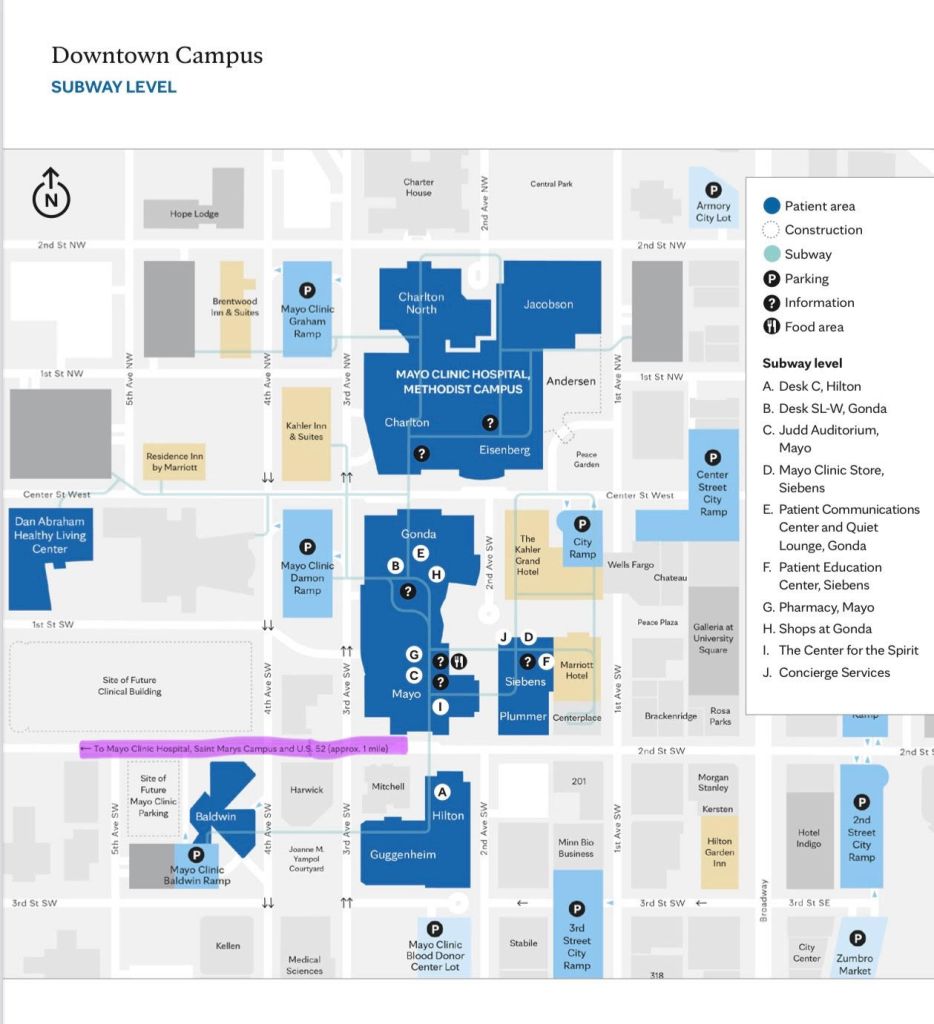
I’m not criticizing Mayo for not prioritizing addiction services, but I am wondering aloud why they haven’t — because it’s clear they haven’t. The Addiction Services are located about a mile from the downtown clinic, and you can’t get there while being protected from the elements. There’s no pedestrian subway or skywalk to get there. You have to go outside…which seems to indicate that people who are getting addiction services aren’t typically getting all the other health services.
Here’s what I’m thinking:
- Addiction services aren’t a priority, as evidenced by the fact that they are far-removed from the rest of the services.
- Which means that when someone goes to Mayo for an initial diagnosis, addiction isn’t top of mind, since it’s not located near the other offices.
- Which maybe means that people who are treated for addiction at Mayo already know they have addiction before going there, since they are not going through a battery of other diagnostic services in order to land on the diagnosis of addiction.
- Which makes me wonder about the vast majority — estimated to be about 90% — of those with addictions who don’t get treatment (AMA).
- Which makes me think that people who have addiction may know they do but choose not to address it.
- Which makes me think that we have our work cut out for us, since we say we believe addiction is a chronic, progressive, lethal disease like cancer and Type 2 diabetes, but society still, STILL, in 2025, treats it like it’s a choice caused by a weakness of character.
- Which makes me remember that we actually have a test for addiction…or two, actually.
- The first is the Marty Mann Test for Addiction. I wrote about it here (https://guidedbyguida.guide/2023/01/03/the-marty-mann-test-for-alcoholism/) from the perspective of alcoholism, but it would also work for other drug addiction. Just figure out a measurement for “social” use of the drug of choice. I really can’t give an idea of what social use of cocaine or heroin is, but I’m sure a person who uses either of them “just absolutely knows” ze is using it socially, and so that standard would apply.
And so, “The Test: Select any time at all for instituting it. Now is the best time. For the next six months at least decide that you will stick to a certain number of drinks a day, that number to be not less than one and not more than three. [Or the number of hits, lines, however your drug of choice is measured…and don’t go above it for at least six months.]
“Absolutely no exceptions, or the test has been failed.”
That’s it; that’s the test. Stick to a specific amount of reasonable use for six months, and make zero exceptions. Don’t quit using for six months; use a “reasonable” amount at every occurrence of using. If you can do that, you don’t have addiction, but if you can’t, you do.
- The second test is direct biomarker testing. Since there’s really not a test for abstinence, the next best test is a fingernail or hair (though I prefer fingernail) test to see if a person has been using “socially” in the past several months. It basically measures the outcome of the Marty Mann Test.
If you or someone you know has failed either test, I bet Mayo Clinic has stellar addiction treatment, but so does your community. Start there.
References
90% who need substance-use disorder treatment don’t get it | American Medical Association


 Guided by Guida
Leave a reply to Ab Cancel reply