
Is addiction a disease, or, is it, as Johann Hari asserts, a lack of connection?
Johann Hari is an award-winning journalist and writer. From his own bio, his education is that “He studied Social and Political Science at King’s College, Cambridge, and graduated with a Double First.” Admirable, but does that make him an expert on addiction? I contend that it does NOT. His website also doesn’t mention his troubles with plagiarism and his giving back one of his awards. (Guardian)
“But Guida, he’s written a bunch of books! Surely he’s qualified!” He is qualified…to write books. And he has…on addiction, depression, thinking deeply, and weight-loss drugs. Writing books on a variety of topics doesn’t make him an expert on addiction, and so I don’t think we should give credence to his theory. In my line of thinking, suffering from a disease doesn’t make you an expert on it, either, so no need to tell me how you know people who have addiction who agree that they wouldn’t if not for that lack of connection. Having a disease, be it addiction, cancer, diabetes, etc., makes you an expert on YOU and your journey. Shoulda, coulda, woulda…but only for YOU.
For the uninitiated, Hari uses the rat park experiment from the 1970s as his rationale that addiction is merely a lack of connection. Put a rat in a cage by itself with water or a morphine mix to choose from; the rat will return to the morphine until it overdoses and dies. Put a rat in a cage with other rats as well as the choices of water or morphine mix, and the rats were less likely to become addicted to morphine compared to rats that were isolated.
The truth is that the study had a small sample and results couldn’t be replicated, and Hari overstates the findings anyway. He indicates that NO rats became addicted when they were in community, and so we’re supposed to believe that the rat didn’t use morphine because it’s content with its friends.
Hari suggests that the Vietnam War was our own rat park and evidence that lack of community “cures” addiction.
“In Vietnam, 20 percent of all American troops were using loads of heroin, and if you look at the news reports from the time, they were really worried, because they thought, my God, we’re going to have hundreds of thousands of junkies on the streets of the United States when the war ends; it made total sense. Now, those soldiers who were using loads of heroin were followed home. The Archives of General Psychiatry did a really detailed study, and what happened to them? It turns out they didn’t go to rehab. They didn’t go into withdrawal. Ninety-five percent of them just stopped.”
I’ve written before about how the urine cup came into vogue. You can find that here: “alcohol-and-other-drug-testing-no-room-for-gotchas.” The point is that Vietnam vets were required to be free from heroin before coming back to the States…and they were. But think about the most used drug…and the one that’s missing from most urine cups: alcohol.
Vietnam vets weren’t using heroin, but they certainly weren’t free from addiction, and that’s quite obvious today. Our Vietnam veterans have not fared as well as Hari would lead us to believe. In fact, 17% of them have active addictions per this 2023 study, “Substance Use in U.S. Vietnam War Era Veterans and Nonveterans: Results from the Vietnam Era Health Retrospective Observational Study.” (tandfonline)
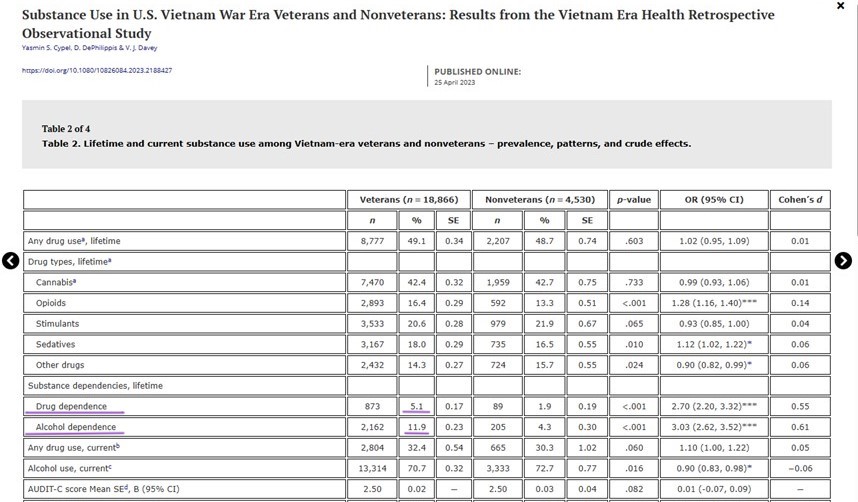
Addiction is a disease that may be exacerbated by a lack of connection, but dismissing the disease aspect is plain wrong. This isn’t about Johann Hari being wrong…though he is. It’s about us…those of us looking to blame someone for having a disease, those of us looking for an excuse to point a finger, those of us who say we believe addiction is a disease but who really think it MIGHT be a disease, but it’s not, like, a REAL disease. Hari has been given a voice for too long, not because what he said is brilliant or right, but because those of us in the field of addiction are looking for easy answers that don’t exist.
Addiction is a disease. Treatment works. Recovery is possible.
References
https://www.theguardian.com/media/2011/sep/14/johann-hari-apologises-orwell-prize
https://www.tandfonline.com/doi/full/10.1080/10826084.2023.2188427#d1e619
______________________________________________________________________
This isn’t a reference, but I see my rant against Hari’s lack of expertise isn’t the only one. Read on for more! https://thequietus.com/opinion-and-essays/black-sky-thinking/johann-hari-plagiarism-mental-health-bad-science/

 Guided by Guida
Leave a reply to Joe Jones Cancel reply