
My navel gazing generally consists of my asking myself and others, “Is it me?” Usually it isn’t, at least in my own mind, which is why I was excited to read Influencer by Kerry Patterson, Joseph Grenny, David Maxfield, Ron McMillanm, and Al Switzler. It’s an old book, as far as books go…published in 2007, and I contend that it needs to both be updated to include social media influencing and to have a name change so that people don’t think the book is about social media “influencers” as we commonly think of them these days. It’s not.
For me, this book was the antidote to The Let Them Theory by Mel Robbins that I recently wrote about (https://guidedbyguida.guide/2025/04/10/how-the-let-them-theory-helps-in-addiction-recovery/). Rather than thinking we have no ability to change others, this book gives some concrete ways to do just that. And it also gives us some cautionary tales, which are what I liked best.
First, in order for anyone to change behavior, and EVERYTHING is behavior, two questions must have affirmative responses: Is it worth it? Can I do it? The book went way off track when talking about addiction, so don’t read it for THAT, but here’s what I was able to extrapolate: no one can ever get anyone to change behavior unless the person who needs to change believes that the change is worth it and that the change is achievable.
For all those who love someone with the disease of addiction, let me repeat that: no one can ever get anyone to change behavior unless the person who needs to change believes that the change is worth it and that the change is achievable.
I cannot tell you how many times I’ve heard that “My daughter/son/husband/wife/friend/fiancé needs help, and no one will help!” Then I listen to the hurdles, and I instantly recognize that the loved one can’t answer the questions affirmatively.
Do I want to change?
Maybe? No? I mean, I know I SHOULD change! I know that stopping substance use would be better for me physically, spiritually, emotionally, and financially, but do I WANT to? Maybe. Maybe the desire to change is less than the desire to stay the same. Maybe the fear of changing is worse than the fear of dying. Maybe the grief of stopping is greater than the grief of the negative consequences of continuing to use. Maybe. So, no, I may not want to stop.
Can I change?
Is it actually possible to stop using alcohol and other drugs and live a life of recovery? I. Don’t. Know. I know I should, but I’ve tried in the past, and I wasn’t successful. In fact, in the past, when I’ve told loved ones that I’ve stopped, rather than supporting me, they mocked me. Or they offered me a different drug than my “drug of choice,” as though I’m not addicted to everything. So, I don’t know if I can change. I haven’t been successful in the past, and no one loves living like I’ve been.
Can you see how scary this behavior change may be? I know I should. I kind of want to. I’m just not sure that I can.
The authors explain about this new-fangled method called Motivational Interviewing to motivate people. It’s no longer new, but it’s still worth using to help people address their ambivalence about change (ncbi).
The other point the authors make that really made me think, “Yup. It’s me” is in telling stories to change behavior. I talk a lot. Like A LOT. So that’s one reason I really enjoy working with the amazing trainer Mike McGowan on “What Are You Thinking About” on Instagram (https://www.instagram.com/mikeandguida/) and Facebook (https://www.facebook.com/MikeAndGuida). Mike and I talk about all things substance-related, and we tell all sorts of stories to capture attention. And when I’m not talking, I’m writing stories.
But a recent post from MikeAndGuida had people calling us out as wrong, irresponsible, judgy, because, from at least one person’s perspective, we’re stupid and getting kickbacks from the pharmaceutical companies! We’re not. At all. Ever. But that’s the problems with stories. In order for people to care about your stories, they have to understand, believe, and be motivated by you.
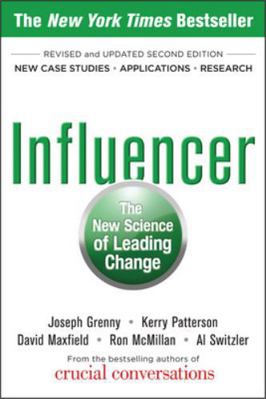
Influencer says they have to understand what you’re saying, so the words you use have to have the same meaning as those words have for them. For example, when someone says “I’m an addict,” and ze means that ze is in recovery, the listener needs to know that “addict” has that meaning. Instead, far too often, when a listener hears “addict,” stigma steps in, and that label has horribly negative connotations. That’s why the language of recovery has become so important in this field.
Influencer says they have to believe you. The resistance to believe stories, per the authors, are two-fold: “First, others might not have confidence in your expertise. Why would anyone listen to a moron? […] Second, even when others find you to be perfectly competent, they may mistrust you in the traditional sense of the word – they may doubt your motive.” So, my trying to convince strangers that I’m competent and not working for a pharmaceutical company is probably folly.
And, finally, Influencer says, they have to be motivated by you. “Finding a way to encourage others to both understand and believe in a new point of view may not be enough to propel them into action. Individuals must actually care about what they believe […] If emotions don’t kick in, people don’t act” (pages 59-62).
We can’t make others change, but we can absolutely help to motivate them. It’s not just me.
References
https://www.ncbi.nlm.nih.gov/books/NBK571068/
Influencer: The New Science of Leading Change (2007) by Kerry Patterson, Joseph Grenny, David Maxfield, et al


 Guided by Guida
Leave a reply to Joe Jones Cancel reply